En
EnWhile having a tragic cost in human lives, and causing significant property damage, the impact on shipping from Hurricane Irma may not be as severe as initially expected. Following landfall around the Florida Keys, the storm has tracked west rather than east of Florida according to NOAA.
As at Monday morning the U.S. Coast Guard has maintained the main Florida container ports (Port Everglades and Miami) at a closed status. On the eastern seaboard and further north
Savannah is closed, and may remain so through Tuesday. Charleston is open, though the USCG has declared condition Yankee and so a closure depending on conditions cannot be ruled out.
Panjiva data shows that the big Florida ports accounted for 4,130 TEUs per day of imports in September 2016, with the average increase in the past 12 months equivalent to 7.0%. That would suggest 4,425 TEUs of capacity disrupted. Industries relying most on the ports include chemicals, building materials (led by lumber) and auto-parts. Building materials interruptions will be keenly felt across the region as the reconstruction process begins.
For Savannah the disruption may be equivalent to 6,125 TEUs, bringing the total currently shut-in to 10,550 TEUs. Even a few days of closures can make a significant difference, as seen by Houston which saw a 16.6% drop in handling on a year earlier as a result of Hurricane Harvey late in the month.
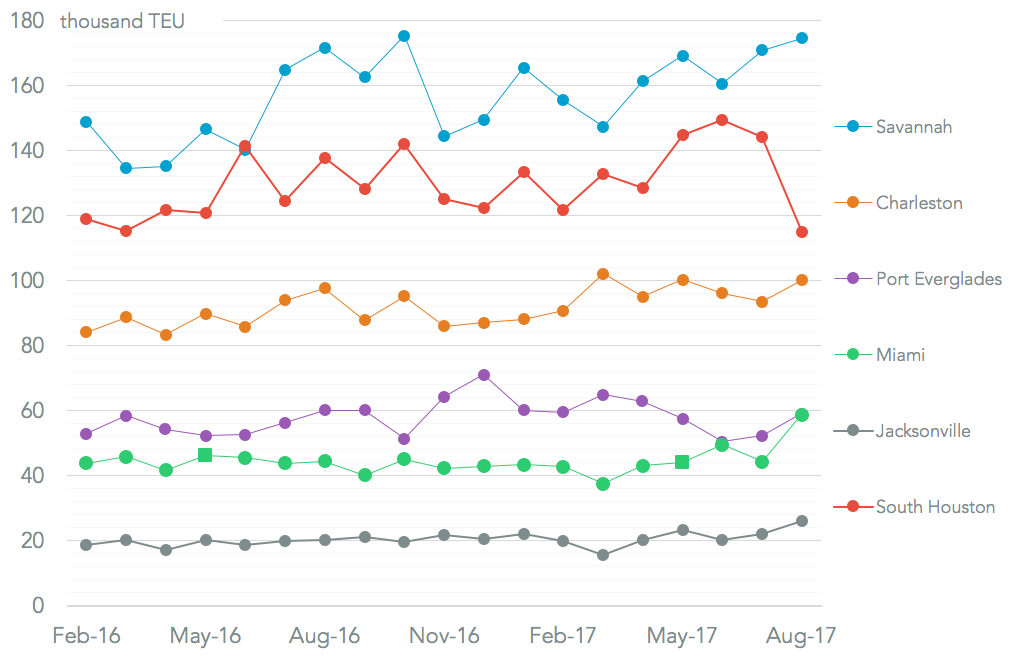
Source: Panjiva