En
EnGermany’s Chancellor Angela Merkel is scheduled to meet U.S. President Trump on March 17, Deutsche Welle reports, with trade likely to feature on a packed agenda. At first glance this could be a controversial meeting. The President’s trade advisor, Peter Navarro, has been highly critical of Germany’s trade policy, as discussed in Panjiva research of January 31. Additionally, the President has been highly supportive of the U.K. ahead of potentially rancorous Brexit talks.
Yet, recent meetings between the President and the premiers of Japan and Canada, and between Commerce Secretary Wilbur Ross and his South Korean counterpart suggest this won’t be the case. Instead President Trump may look for commitments on investment and export potential, rather than threatening tariffs and currency manipulation labels. Any future deal on trade will necessarily require talks between the EU and the U.S., rather than bilateral talks with Germany as Navarro has suggested.
Nonetheless, Panjiva’s analysis of the top 250 export lines from Germany to the U.S. shows the most important export area for the U.S. is aerospace (11.9% of exports in the 12 months to January 31) while for Germany it is autos (19.2%). However, it is worth noting the U.S. also exports vehicles to the U.S. (13.3% of the total) while Germany ships aerospace parts (2.4%). The countries are also closely tied in pharmaceuticals, accounting for 5.1% of U.S. exports and 11.0% of Germany’s, which may be one area of leverage for Germany given President Trump’s aims to cut healthcare costs.
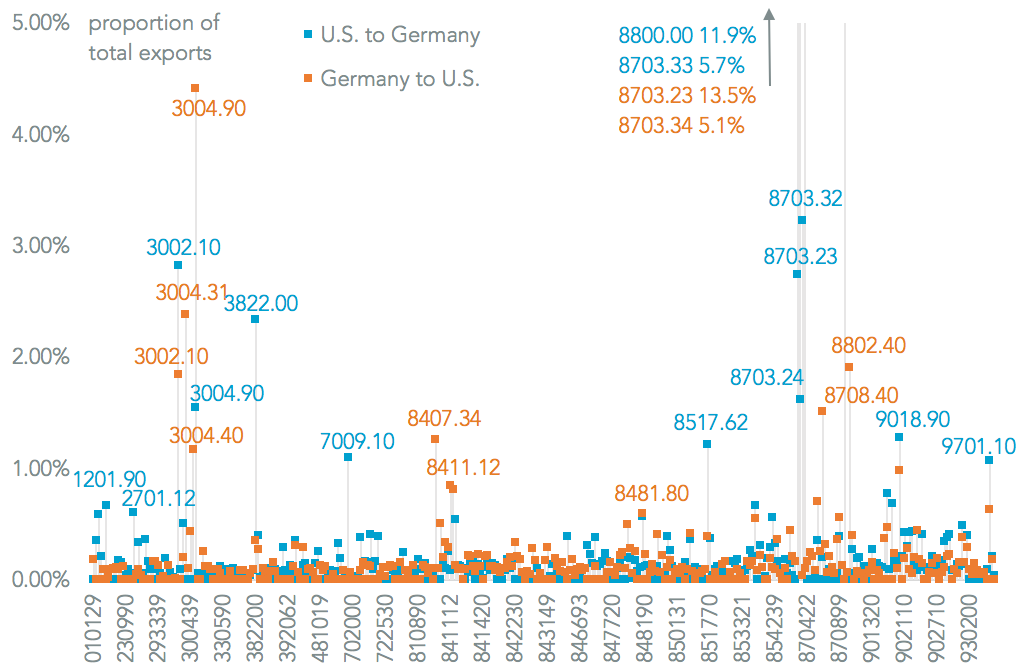
Source: Panjiva
Update (3/13) Report updated to reflect delayed meeting from March 14 due to U.S. weather conditions.